When you build a house or fix up an old one in China, you have to pick window sizes. This is important. It’s not just about making the house look good. The size changes how well the window works. It changes how much energy you save. It also has to follow national building rules. There is no single “average” window size for every home. It depends on where you live. It depends on the room. It depends on the building style. But there are some common standard sizes that many people use.

Builders know these sizes. They come from years of building. They also come from rules in Chinese laws. This guide shows the most common window sizes for homes. It groups them by type. It helps homeowners, designers, and builders make smart picks.
Article Overview
What Are Normal Window Sizes in Chinese Homes?
No single number fits all homes. But typical window sizes in China follow some patterns. They depend on the room.
Living rooms need bigger windows. You want lots of sunlight. You want a nice view outside. Common widths go from 1500 mm to 2400 mm. Heights go from 1200 mm to 1800 mm.
Bedrooms need more privacy. But you still want fresh air. Standard widths are 1200 mm to 1500 mm. Heights are also 1200 mm to 1500 mm.
Kitchens and bathrooms use smaller windows. They sit higher on the wall. Main job is letting out steam and smells. Typical sizes are 600 mm to 900 mm wide. Heights are 600 mm to 1200 mm high.
These numbers are for whole windows. Like a window with two panels that open. A single panel is usually narrower. Often 600 mm to 900 mm wide. This keeps it safe to open. It also keeps the window strong.

Common Window Types and Their Standard Sizes
Fixed Windows are for light and views. You cannot open them. They are sealed shut. This makes them best for stopping heat and noise. Their standard sizes are 600 mm to 2400 mm wide. Heights are 600 mm to 1800 mm high. Really big custom ones, like floor-to-ceiling glass, can be over 3000 mm by 2400 mm. But they must use tempered or laminated glass. They need extra reinforcement. Rules say so. Good things: great insulation, lower cost, wide views. Bad things: no air flow. Hard to clean on high floors. Important: if height is over 2000 mm, glass must be thicker. Usually at least 8 mm. This handles wind pressure.
Casement Windows are very popular in China. Many mid-range and high-end homes use them. A single panel standard size is 600 mm to 900 mm wide. Height is 900 mm to 1500 mm. For two panels, total width is usually 1200 mm to 1800 mm. Rules say a manually opened panel should not weigh more than 60 kg. Bigger panels need special hinges or help to open. Good points: they open fully. Best air flow. Seal tight when closed. Keep rain out well. Bad points: outward-opening ones can be dangerous in tall buildings. Inward-opening ones take up room inside. When installing, leave a small gap. About 2 mm. This lets the aluminum frame expand and contract with temperature changes.

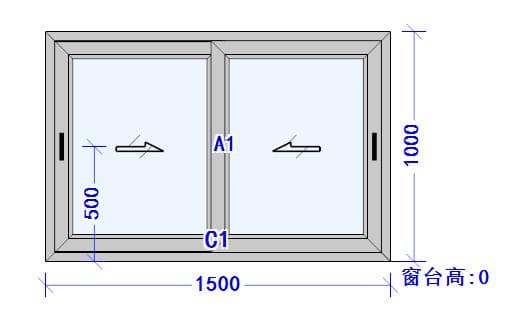
Sliding Windows work well in city apartments. Space is tight there. Common setups have two panels. Total width is 1200 mm to 1800 mm. Height is 1200 mm to 1500 mm. Three-panel windows can be 2400 mm to 3000 mm wide. A single sliding panel is usually 600 mm to 900 mm wide. The rollers must be strong. They carry heavy weight. They must pass durability tests. Good things: they save space. Easy to use. Look modern. Bad things: only 50% opens for two-panel types. Tracks collect dust. Not as airtight as casement windows. For care, in busy areas, change rollers every 5 to 7 years.

Top-Hung Windows are great for bathrooms, kitchens, and high-rise buildings. Safety and rain-proof air are important there. Their standard sizes are 600 mm to 1200 mm wide. Heights are 400 mm to 900 mm high. They must meet water tightness standards. Good things: you can leave them open in light rain. Safe because opening is small. Compact size. Bad things: limited air flow. Hard to clean outside. For hardware, use rust-proof hinges. Especially near the coast.
Tilt-and-Turn Windows are more common now in high-end home projects. Typical sizes are 800 mm to 1200 mm wide. Heights are 1200 mm to 1800 mm high. They need good quality multi-point locks. Great thing: two functions. Tilt open for safe air. Turn fully open for cleaning. Excellent insulation too. Bad things: cost more. Need space inside. Harder to install. Best for bedrooms and living rooms. You get good air and safety.
Double-Hung Windows are less common in new Chinese buildings. But some renovations use them. Western-style houses too. Typical sizes are 900 mm to 1200 mm wide. Heights are 1200 mm to 1800 mm high. They use springs or weights to balance. Good point: top and bottom panels open. Classic look. Bad point: don’t seal as well as European-style windows. Hard to find parts or local help.
How to Pick the Right Window Size for Your Home
Choosing window size means thinking about a few things.
First, follow building rules. For enough light, glass area should be at least 15% to 20% of floor area. Openable area must be at least 5% of floor area in bedrooms. And 8% in living rooms. In earthquake zones, for safety, opening panel height might be limited to 1500 mm.
Second, measure the wall opening right. Subtract 10 mm to 15 mm from each side. That’s total 20 mm to 30 mm. This leaves space for installation and sealant.
Third, pick window type based on room use. For living rooms, good choice is big fixed window with openable ones. Like fixed center with casements on sides. For bedrooms, to get air and safety, tilt-and-turn or casement windows work. For bathrooms and kitchens, small top-hung or high fixed windows are best.
Also, think about local weather and window facing. South-facing windows need some shade. Reduces heat in summer. North-facing walls can have more glass. Helps with light. In coastal areas, you need windows that handle strong wind. Use rust-proof hardware.
Finally, remember performance matters more than size. A smaller window with double glazing, warm edge spacers, and low U-factor will be more comfortable and save more energy than a big window with single glass.
End
Common Chinese home window sizes follow some patterns. Like 1200 mm by 1500 mm for a bedroom. Or 1800 mm by 1500 mm for a living room. But the “right” size always depends on your project. At the start of design, talk to a good architect or window supplier. Custom sizes are possible. But they might cost 15% to 30% more. They also need careful engineering checks. By picking windows that fit national rules, your local weather, and what you need, you get good balance of look, performance, and rule following. This helps make sure your windows work well for your home for many years.