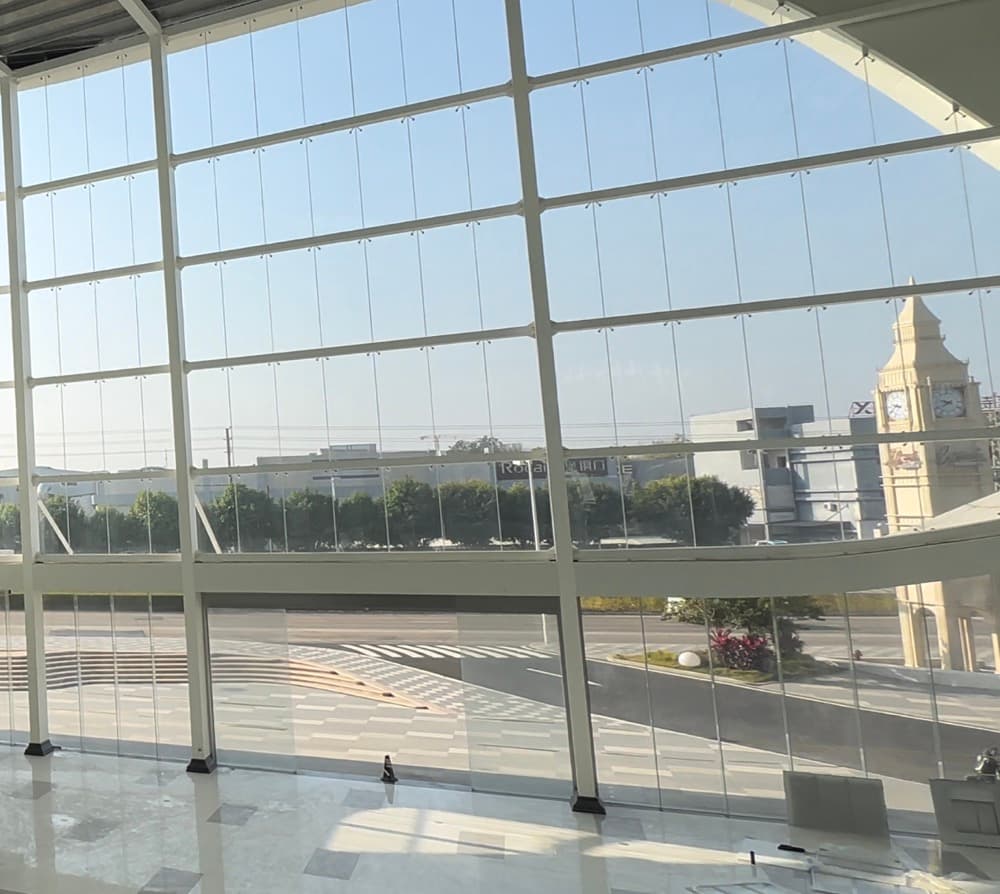
Why Choose Full Glass Curtain Walls? Daylighting & Thermal Insulation Advantages
Article Overview
Full glass curtain walls are modern architecture with natural daylighting, ranging from commercial buildings, residential buildings and public spaces. They integrate visual appeal, energy efficiency and expansive views to create a comfortable and high-efficiency indoor environment, because they can maximize the utilization of natural light.
Full Glass Curtain Wall Design: Glass Fins, Panels & Installation Tips
For the installation ,it is generally composed of glass fins and glass panels. Under normal circumstances, the thickness of glass panels should not be less than 10MM; for laminated glass, the thickness of each single layer should not be less than 8 mm, and the cross-sectional thickness of glass fins should not be less than 12MM. Mechanical suction cups are generally required for installation, with the key focus being that the surface of glass panels should not be in direct contact with other rigid materials.
SIUPA designers suggest that full glass curtain walls are typically applied to the first and second floors. 7MM gap is reserved between adjacent glass panels, which are bonded with transparent glass sealant, as shown in the video. The visual effect is stunning when walking from one side to another. The main entrance is a frameless sliding glass door. The glass can be ultra-clear glass or regular glass.
Full Glass Curtain Wall Installation: Anti-Spontaneous Breakage & Fixing Methods
For the curtain wall design, the glass is installed flush against the tile surface, but in reality, there is no direct contact between them. Instead, embedded parts are placed underneath the tiles prior to tile installation. This measure is intended to prevent spontaneous glass breakage. More importantly, the fixation of large glass panels does not concentrate all the weight at the bottom of the glass (on the ground); instead, the glass is suspended from the crossbeams via hanging rods.
Glass Selection for Curtain Walls
For glass panels with a single-piece area of less than 4 sqm, regular glass can be used. If the single-piece area is more than 4 sqm, ultra-clear glass is recommended. The reasons are as follows:

- The larger the glass panel, the higher the risk of spontaneous breakage, and ultra-clear glass has a lower spontaneous breakage rate compared to regular glass.
- Larger glass panels require greater thickness. However, as the thickness of regular glass increases, its light transmittance decreases significantly.
Curtain Wall Philippines Supplementary Key Differences for Clients

- Typhoon Resistance:The metal frame structure of conventional provides superior protection against strong typhoons is very important such as the Philippines and parts of Africa, which is a core consideration for clients when making order. In contrast, full glass curtain walls are only suitable for low-rise applications without strong wind loads.
- Cost Advantages:aluminum frame curtain walls, which combine aluminum frames with standard glass panels, that is price advantages in SIUPA WINDOWS because of China’s supply chain . Full glass curtain walls are high budget product, and that is imperative to verify technical proficiency of construction builder .The primary cost is installation ,not the production price.
Curtain Wall Africa Supplementary Key Differences for Clients
Strong winds are prevalent in coastal regions of Africa (e.g., coastal Nigeria and Kenya). When procuring , it is very import to Check wind load rating clearly. Prioritize aluminum frame not for full glass curtain walls ,it is only suitable for buildings (Floors 1–2) in low-wind inland areas and it’s equipped a hanging rod load-bearing structure. For profiles thickness suggest: ≥ 3.0 mm .
Given the heightened concerns in Africa, regarding the vulnerability of large glass panels to spontaneous breakage or be damaged , SIUPA WINDOWS uses double-layer laminated glass to resist general intentional damage, and also offers bulletproof glass as an optional upgrade.