Casement windows open from the side. You turn a handle to push them out. People say these windows save a lot of energy. This is not just talk. It comes from science. It comes from tests. It comes from real use over many years in many countries. Good casement windows, made and put in the right way, work better than sliding windows or double-hung windows. They stop air leaks. They keep heat in or out. This piece talks about why casement windows save energy. It looks at how they seal, what materials they use, and how they work in different weather.

Article Overview
Main Reason: Squeeze Seal
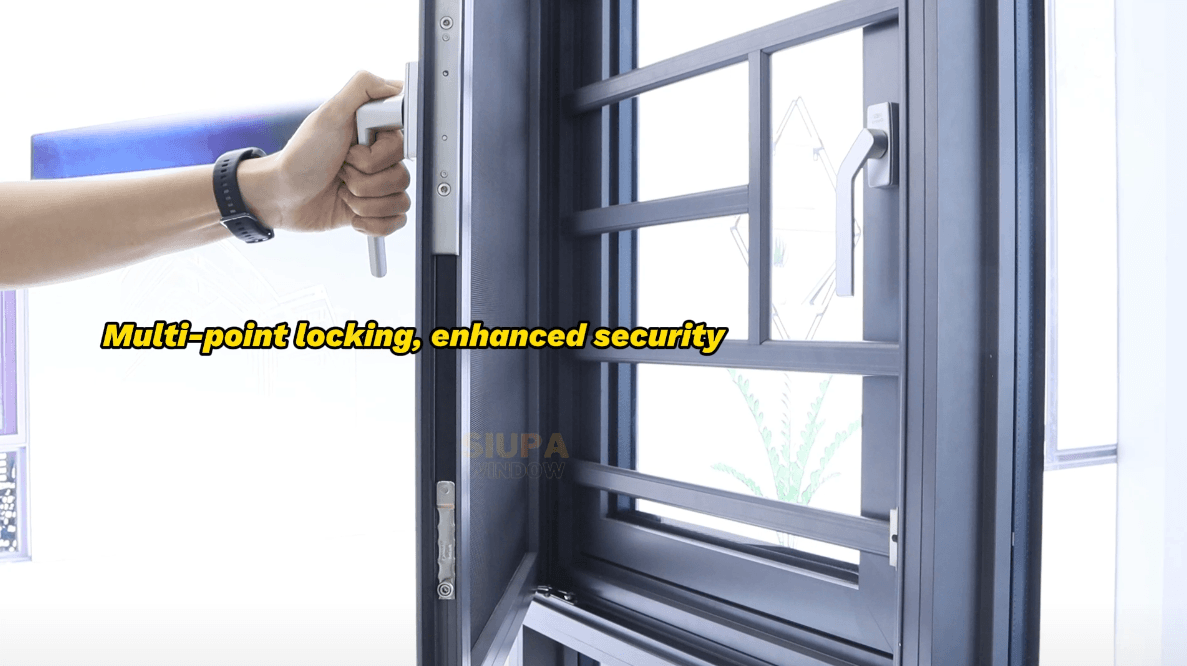
Casement windows save energy mostly because of how they close. They use a squeeze seal. Sliding windows move on tracks. They always have small gaps. Double-hung windows also have gaps. Casement windows are different. They swing shut. When you turn the handle,multi-point lock pull the window tight. The whole window presses against the seal.
This makes a tight wall around all four sides. No gaps. In China, there is a test called GB/T 7106-2019. It checks air tightness. Good casement windows score Level 6 or 8. That means very little air leaks out. Maybe 0.5 m³/(m·h) at 10 Pa pressure. Normal sliding windows score Level 4 or 5. They leak more. About 1.5–2.0 m³/(m·h) at the same pressure.
This matters for energy. Air leaks cause big problems. They can add 10% to 30% to your heating and cooling bills. Really hot or cold weather makes it worse. Stop the leaks, and you use less energy. Your HVAC system does not work as hard.

Less Air Leak: Real Savings
Air leak is not just about feeling a draft. It wastes energy and money. Think about Harbin. Very cold there. Heating degree days are over 3800°C. A small leak lets warm air out. Cold air comes in. The China Academy of Building Research did studies. They looked at a 100-square-meter apartment. They changed old sliding windows for good casement windows. The sliding windows had a U-value around 2.4 W/m²·K and leaked a lot. The casement windows had a U-value around 1.6 W/m²·K and leaked very little. Heating energy use went down by 18%. That saves about 3500 kWh each year.
Think about Guangzhou. Hot and wet there. Less air leak means less hot, wet air comes inside. Your AC does not have to work as hard to cool and dry the air. Summer energy use can go down by about 10%. The sun still heats the room through the glass. But a tight building helps a lot.
Other countries see the same thing. In the US, ENERGY STAR® says casement windows leak less than 0.1 cfm/ft². Sliding and double-hung windows often leak more than 0.2 cfm/ft². Tests everywhere show the same result. Casement windows are just better at stopping leaks.
Heat Control: More Than Just Glass
Glass covers about 70% of a window. But the whole window matters. The frame, spacers, seals, and how you put it in all change the U-value. That number tells you how much heat moves through. Casement windows do well here for three reasons.
First, they can hold heavy glass. Good casement frames are strong. They can take double or triple low-E glass. The glass can have argon or krypton gas inside. In China, a standard casement window with double glass has a U-value of 1.5–1.8 W/m²·K. A sliding window, same size and glass, has a U-value of 2.2–2.5 W/m²·K. Why? The sliding window leaks. It loses the glass’s good effect.
Second, many casement frames now use thermal break aluminum. This follows GB/T 8478-2020. The thermal break stops heat from moving through the metal. Frame U-value goes from 3.5 W/m²·K down to 1.8 W/m²·K. PVC frames and wood frames are even better.
Third,multi-point lock help the seal. They press the EPDM or silicone seal evenly around the whole window. No weak spots. No gaps. Without this, even good glass and frames can leak heat.
Good casement windows meet China’s energy rules. Rules like GB 50189-2015 for public buildings. Rules like JGJ 26-2018 for homes. They work well in cold places. They work well in hot places.

Things That Change Real Energy Saving
Casement windows are a type. Not all are good. Real energy saving depends on a few things.
Material quality matters. Cheap aluminum with no thermal break is bad. Single glass is bad. No low-E coating is bad.
Installation matters. JGJ 103-2017 says how to do it right. Bad sealing, wrong foam, or a crooked frame cause leaks. You lose the factory performance.
Hardware matters. Old hinges or worn locks stop the seal from working right. The window won’t close tight.
Climate matters. In Shanghai, hot summers and cold winters. You need low-E glass that controls solar heat. Look for SHGC around 0.4–0.5. This keeps heat out in summer but lets some sun in during winter.
Maintenance matters. Clean the tracks. Change old seals every 10–15 years. This keeps the window tight.
Good and Bad for Energy
Good things:
Least air leak of any opening window. Less heat loss or gain.
Best U-values with good glass and thermal break frames.
Good for noise too. Rw around 35–40 dB. Makes the room feel better.
Works with triple glass, gas fills, and warm edge spacers.
Bad things:
Costs more at first. About 20–30% more than sliding windows. Hardware and making them is harder.
Needs space to open. Outside swing can hit balconies or walkways. City rules might stop you.
Wind can be a problem. High buildings, over 30 floors, need strong hinges and locks. Wind pushes hard.
No window AC units. Some renters might not like this.
Even with these, casement windows save money over time. Life cycle cost is 10–15% lower than sliding windows. This is over 30 years. Works best in cold places that need a lot of heating.
Tips for Different Weather
Very cold places : Get casement windows with triple glass. Argon gas. Low-E coating. Wide thermal breaks. Pick high SHGC, around 0.6–0.7. This lets winter sun help heat the room.
Cold places: Double low-E glass is fine. Focus on air tightness. Make sure U-value is under 1.8 W/m²·K.
Places with hot summers and cold winters: Use special low-E glass. It cuts solar heat. SHGC should be lower. Keep U-value low too.
Hot wet places: Air tightness is key. Outside shade helps. Casement windows still beat sliding windows on air leaks. But think about space. Sliding might fit better.
End: Yes, Casement Windows Save More Energy
Look at the facts. Air tightness. Squeeze seal. Less leak. Better U-values. Casement windows win over sliding and double-hung types. The way they work just seals better. New materials help too. Thermal break frames. Low-E glass. Gas fills. All make them even better.
In China, look for GB/T 29908-2013. That label means certified energy performance. Real savings happen. Over time, you pay less for energy. Your home feels more comfortable. You put out less carbon.
For homeowners, builders, and rule makers who care about long-term energy use? Pick casement windows. Choose the right type. Put them in the right way. Take care of them. They are a smart choice. Works for your wallet. Works for the planet.