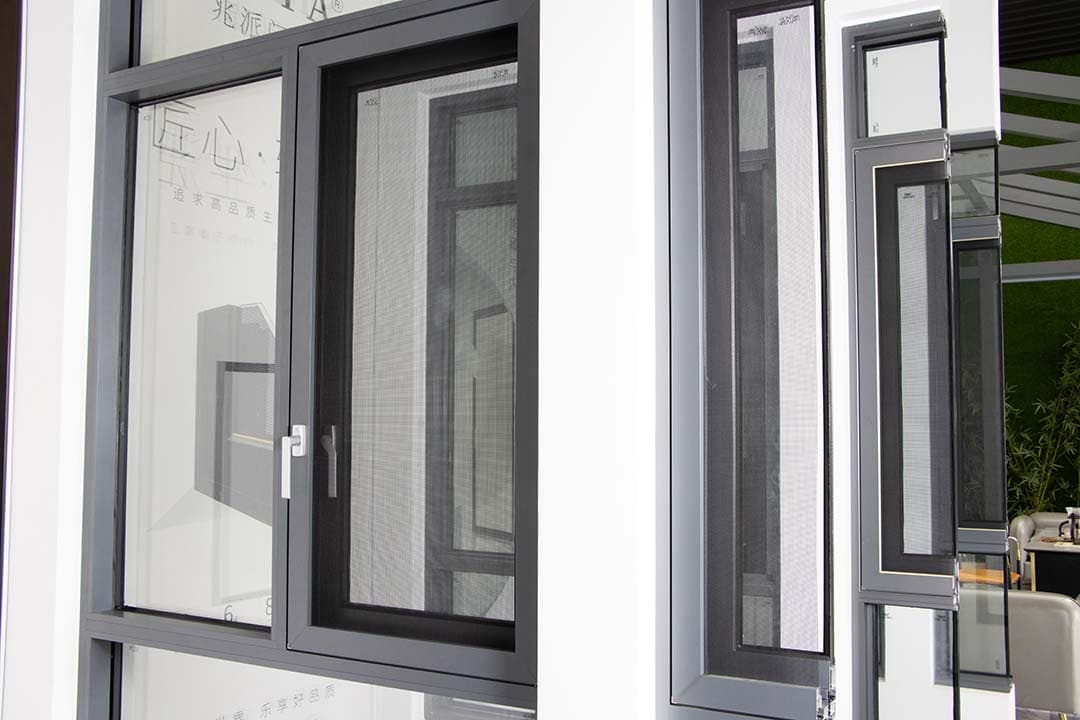
Casement Windows: Key Benefits, Options, and The choice of windows
Sound proof ,heat insulation ,safety ,water proof is The key benefits of casement windows.
Casement windows are hinged on one side and open outward like a door, operated by a crank handle.
Article Overview
Key Benefits of Casement Windows

1. Excellent Ventilation
Casement windows can swing fully open, allowing 100% of the glass area to serve as an air inlet,Casement windows unlike double-hung or sliding windows, which is typically open only halfway(as the photo show ). This makes them ideal for kitchens, bathrooms, or any room needing strong cross-ventilation.
but in some house design ,there are some special cases where the opening area of the window is very small.For casement windows, this can result in a small glass daylight area.
Take an ordinary casement window as an example:
the frame width is about 5 cm, while the frame width of the opening sash is about 6.5 cm.
As a result, the frames alone take up more than 20 cm, leaving very little area for transparent glassthey provide up to twice the airflow of standard sliding windows.
3. Casement Windows have Unobstructed Views
with out the center rail, mullion, or vertical stile interrupting the glass, casement windows offer clear, panoramic views. This also maximizes natural light entry, brightening interiors and enhancing visual spaciousness.
4. Casement Windows Enhanced Security
Casement windows are closed by locking points, so the most vulnerable part of the window to break-ins is the glass.Therefore, SIUPA recommends that if you require casement windows with anti-theft properties, you should use multi-layer laminated glass($13-$17 more for upgrade charge).

For enhanced security, bulletproof glass can also be considered($200-$230 more for upgrade charge,It can withstand the impact of 7.62mm bullets fired from an AK47 at a distance of over 10 meters.).
5. Casement Windows Easy Operation and Maintenance
The crank mechanism allows smooth opening and closing—even for large units—and requires minimal effort. Many models also include tilt-in or 180° rotating sashes for safe, interior-side cleaning of both glass surfaces—especially valuable for second-story installations.In SIUPA windows ,our standard hinges for the casement windows is VBH brand (german brand),up to the test repost ,it can hold 400N presure when it full open.After 35,000 opening and closing tests, the hinges showed no component detachment or cracking

Casement Windows vs. Other Window Types
| Feature | Casement Windows | Double-Hung Windows | Sliding Windows | Awning Windows |
|---|---|---|---|---|
| Opening Method | Hinged on side, opens outward with crank | Two sashes slide vertically up and down | Sashes slide horizontally left and right | Hinged at top, opens outward from bottom |
| Airtightness & Insulation | Excellent, superior sealing performance | Good | Moderate | Excellent |
| Soundproofing | Best | Good | Moderate | Best |
| Ventilation Area | Large, full sash can open | Medium, half of the window area | Medium | Good, suitable for rainy days |
| Anti-theft Performance | Great, secure multi-point locking | Moderate | Moderate | Great |
| Cleaning Convenience | Relatively hard | Easy, sashes tilt in for cleaning | Moderate | Relatively hard |
| Suitable Space | Ideal for high-rise, narrow openings | Traditional homes, classic style | Wide window openings | Bathrooms, basements, rainy regions |
| Cost | Medium-high | Medium | Medium-low | Medium-high |
| Energy Efficiency | Highest | Good | Moderate | Highest |
While casement windows outperform sliding and double-hung types in air infiltration tests (per NFRC Standard ), they do require outdoor clearance to open. Avoid installing them where patios, walkways, shrubs, or air conditioning units might obstruct the swing path.Especially if the exterior of the casement window faces to public area,I do not recommend buy casement windows for the ground floor windows.Sliding windows or double-hung windows would be more suitable.After all, who would use casement windows in public areas?They are mostly used on villas or high-rise residential buildings.
How to Choose the Right Casement Windows
While casement windows outperform sliding and double-hung
How to Choose the Right Casement Windows
1. Accurate Measurement Is Critical
Because casement windows rely on precise fit for optimal sealing, professional measurement is recommended. Even minor installation errors can compromise energy performance and operation.
2. Select Hinge Orientation Wisely
Casement windows come in left-hand or right-hand configurations (determined by hinge placement when viewed from the interior). Consider room layout, furniture placement, and prevailing wind direction to maximize airflow and usability.
3. Comply with Local Building Codes
In bedrooms, egress requirements often apply: the window must provide a minimum net clear opening of 5.7 sq ft (per IRC Section R310). Most casement windows easily meet this if the sash opens wide enough—typically those 28 inches or wider.
4. Choose Frame Material Based on Climate and Maintenance Needs
Vinyl: Low maintenance, good insulation, cost-effective. Ideal for most climates.
Fiberglass: Dimensionally stable, excellent thermal performance, durable—but higher cost.
Clad-wood: Combines wood’s aesthetic warmth with aluminum or vinyl exterior protection. Requires more upkeep than vinyl or fiberglass.
All quality products should meet AAMA/WDMA/CSA 101/I.S.2/A440 standards for structural performance and durability.
5. Verify Performance Certifications
Look for ENERGY STAR® certification and an NFRC label showing verified U-factor, Solar Heat Gain Coefficient (SHGC), and Air Leakage (AL) ratings. These ensure real-world energy savings—not just marketing claims.
Customization: Grids and Glass Options
Window Grids (Grilles or Muntins)
Grids add architectural character without sacrificing function:
Grilles-between-glass (GBG): Sealed inside the insulated unit—no dust buildup, easiest to clean.
Simulated divided lites (SDL): Exterior and interior bars bonded to a single pane, mimicking true divided lites. Preferred in historic districts (per National Park Service guidelines).
Removable interior grids: Offer flexibility but may not suit traditional designs.
SIUPA WINDOWS ,we use GBG as our standard style of grilles ,that is because SDL can not be sound proof ,and it can not used the LOW-E glass ,because LOW-E will be easily scratched on the suface
Aluminum WindowsGlass Upgrades for Performance and Safety
Low-Emissivity (Low-E) Glass: Reflects infrared heat while transmitting visible light—keeping homes warmer in winter and cooler in summer.Tests have shown that when the Low-E coating is on the interior side of the glass, it delivers better heat retention.
When the Low-E coating faces the exterior, it provides superior heat insulation.Therefore, the installation orientation of Low-E glass varies according to different climatic regions.
Argon or Krypton Gas Fill: Inert gases between panes reduce heat transfer. Argon is standard; krypton offers better performance in thinner gaps.
Laminated or Tempered Glass: Required within 18 inches of floors or near doors (per CPSC 16 CFR 1201) for safety. Laminated glass also improves sound insulation.
Triple-Pane Glass: Delivers exceptional insulation (U-factors as low as 0.18) but adds weight and cost—best suited for cold climates.
Tinted or Fritted Glass: Reduces glare and UV damage to furnishings, with SHGC values as low as 0.20.